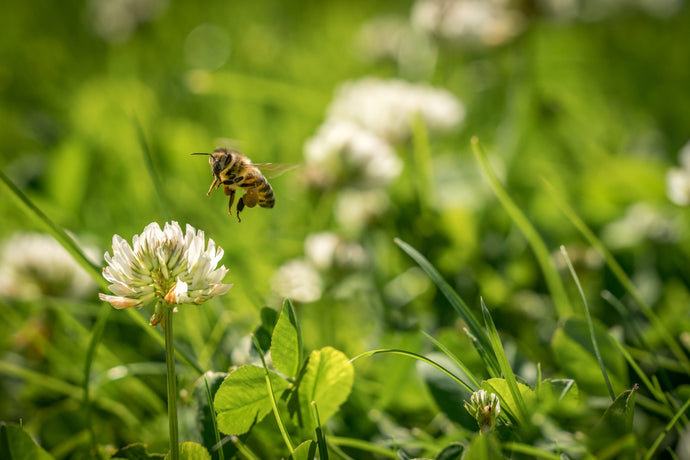


The humble bee is an example to us all
tweetNearly everyone is fascinated with the honeybee and more has been written about the bee than any other species of insects. Bees are the stuff of legends, folklore and especially children’s stories. We humans have been fascinated with the bee for thousands of years – ever since we discovered the taste of honey!
The difference between bees and other insects who consume nectar is that honeybees refine and concentrate nectar to make delicious honey. They make so much honey that they have sufficient for their needs in wintertime (when they consume and metabolize honey to stop them from freezing to death). We like to think that there is sufficient for us to use as well.
Honey is sold as:
- Extracted honey – bottled, liquid honey that has been extracted from the combs.
- Comb honey -honey still in its natural comb.
- Chunk honey – a bottled combination of extracted and comb honey.
When buying honey, you should always look for the word “raw” on the container so that you know the honey has not been processed. This means that no form of heating has been used and all the natural vitamins, enzymes and other nutritional elements are preserved. When honey is heated, the delicate aroma, the yeast as well as the enzymes (which are responsible for activating vitamins and minerals in the body’s system) are partially destroyed. Raw honey is said to be much more nutritious than honey that has undergone heat treatment.
Bees have a weapon to defend themselves and their hives and this is the stinger but because the stinger is modified from a structure found only in females, male bees cannot sting. When the hive is threatened, honeybees will swarm out and attack with their stingers to drive the enemy away.
We have to be a bit careful about bee stings because a very small percentage of the human population is genuinely allergic to bee stings. They experience breathing difficulty, unconsciousness or even death if they are stung and should carry with them at all times an emergency kit of injectable epinephrine, available by prescription from a physician. To the rest of us, a bee sting will cause intense local pain, reddening and swelling. This is a normal reaction and does not, in itself, indicate a serious allergic response. With time, many bee keepers (because they can be stung more frequently than us) no longer redden or swell when they are stung but they will still feel the pain!
Remember that if you have been stung by a bee, firstly scrape but don’t squeeze the sting. You can scrape by using your finger nail or the edge of a credit card. Ease the pain and discomfort with a poultice of fresh mint leaves.
Bees are a good role model for us humans being industrious and hard working but social too! In the wild, they create elaborate nests called hives which can contain as many as 20,000 bees during the summer months while commercial or domestic hives may have over 80,000 bees. The bees work together in a highly structured and organized social order with each bee belonging to one of 3 groups – the queen bee, the drones and the worker bees.
There is only one queen in a hive and she can lay as many as 1,500 eggs or more per day. She usually lives less than 2 years and she is larger than the other bees. Her stinger can be used frequently.
Drones, being males, have no stinger and live for about 8 weeks. Their function is to mate with the queen.
Worker bees make up the main occupants of the hive and are sterile females. As young house bees, they do all the work in the hive itself until they progress to being field bees which of course are the ones that we see regularly gathering nectar and other necessities from gardens, wild flowers, fields and meadows. They can only use their stinger once as they cannot survive once used. Worker bees who are born early in summer will live for about 6 weeks while those born in the autumn or fall will live until the following spring ready to start the bee cycle of life all over again.